
Summary
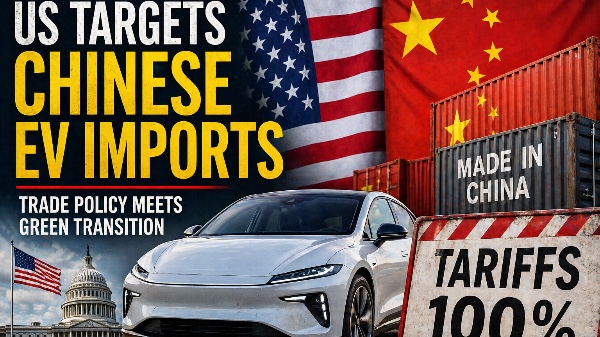
The United States plans to introduce major new taxes on electric vehicles imported from China, blending geopolitics with industrial strategy. The aim is to curb concerns about China’s growing dominance in the global EV sector while protecting domestic manufacturers.
This is more than a trade story. It is political, showing how governments now compete in areas linked to energy transition and national security through economic policy
The Disintegration
Why introduce tariffs?
The US government argues that Chinese electric vehicle (EV) makers receive heavy state subsidies, allowing them to produce vehicles at lower costs and undercut global competitors. Officials say the tariffs are needed to level the playing field for American businesses.
There are also strategic concerns. Control over supply chains—especially batteries and raw materials—is increasingly viewed as a national security issue, with EVs central to the shift away from fossil fuels.
The US is striving to diminish reliance on Chinese manufacturing while strengthening domestic industry through import restrictions.
The Political Context
The timing of the decision is crucial. Both major US political parties have adopted an adversarial stance on China, and trade policy has become a central political issue. Voters strongly support protecting domestic industries, especially manufacturing.
Moreover, the project becomes a component of a broader trend towards economic nationalism. The allocation of resources in essential sectors by governments is no longer exclusively determined by free markets. They actively influence industries via legislation, tariffs, and subsidies.
The US is not alone. The European Union has launched investigations into Chinese EV subsidies, increasing the likelihood of similar measures in Europe.
The Impact on Trade
The tariffs heighten uncertainties for global automakers. Enterprises with supply chains linked to China may need to reorganise their operations or incur supplementary costs. Chinese EV manufacturers may need to reevaluate their strategies, as numerous companies had contemplated entering Western markets.
In the immediate term, US-based companies may gain from less competition. However, blocking cheaper imports could raise consumer prices and slow EV adoption- an unintended consequence of protectionist policy.
Legal Team Involvement.
These trading measures carry significant legal implications.
- International trade lawyers will advise governments and companies on WTO compliance and potential tariff disputes.
- Competition lawyers may assess how the measures affect market dynamics, especially if domestic firms gain more power.
- Regulatory specialists will handle evolving rules on imports, subsidies and supply‑chain requirements.
- Commercial and contracts teams will support companies restructuring supply chains and managing cross‑border risks.
Legal teams are essential for restructuring supply chains and managing cross-border risks for multinational corporations.
Prospects for the Future
This decision marks a major shift in how countries approach global trade. Economic policy is increasingly used as a tool of geopolitical competition, especially in technology and energy.
Further escalation is possible. China may retaliate with its own trade restrictions, raising the risk of a broader conflict. Other countries may temporarily follow the US model, leading to a more fragmented global market.
The communication is unequivocal for enterprises. Trade policy and industrial strategy will continue to shape markets in the foreseeable future, while political risk becomes a significant consideration in corporate decision-making.