
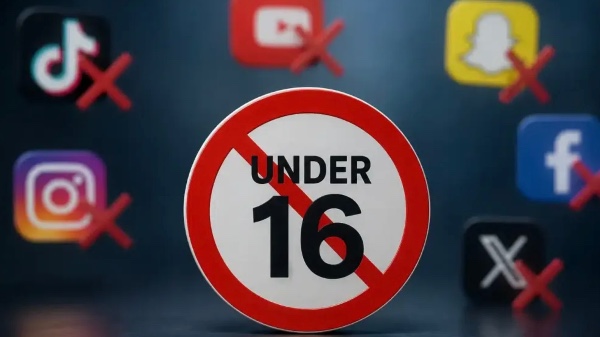
What legal and practical challenges arise from the UK Government’s proposal to ban social media from under-16s?
Short Answer: The proposed ban faces legal challenges over privacy and proportionality, as well as practical challenges as children may use VPNs to bypass the ban.
Development of the Policy:
Teenagers have had their phones surgically attached to their hands for over a decade. Now the government wants to cut off their access to social media entirely. The UK’s proposed ban on under-16s accessing major platforms sounds bold, but the legal and practical obstacles it faces are difficult. The government aims to restrict under-16s from using social media platforms as part of its internet safety strategy. The idea improves on the Online Safety Act, which already requires platforms to protect minors from harmful material. Under the new approach, platforms must include Age Assurance systems that can detect users under the age of 16. Ofcom will be in charge of determining the requirements that platforms must follow.
The policy is driven by concerns about harmful content, addictive design features, and the effect of social media on young people's well-being. Ministers claim that a ban is required to prevent exposure to risks that current protections do not address.
The ban faces serious legal challenges around privacy and proportionality, and significant practical barriers to enforcement that could undermine it entirely.
Analysis:
Privacy and Data Protection Concerns:
To impose the restriction, platforms have to verify the ages of all users. This might include facial analysis and identification documents. These practices create concerns under the UK GDPR, which requires data processing to be necessary and proportional. A system that checks the ages of millions of individuals to identify minors is difficult to justify under this condition.
Article 8 of the European Convention on Human Rights, which guarantees the right to private life, applies here. The volume of data collection necessary for Age Assurance might be viewed as an unreasonable invasion of privacy. Human rights groups such as Amnesty International have raised concerns that the measures might result in data collecting that exceeds what is required for child protection.
Proportionality and Scope of the Ban:
Banning all under-16s from using social media platforms is a major restriction. Courts may consider whether less intrusive methods may produce similar outcomes. Alternatives that prioritise children's rights include default safety settings and targeted bans on high-risk features.
The Public Sector Equality Duty encourages the government to evaluate how the ban may impact various groups. Some young people go to virtual communities for support, especially those who may not have access to secure offline support. If the restriction unfairly impacts certain groups, it may be challenged unless appropriate protections are implemented.
Practical Barriers to Enforcement:
Even if the legal basis is solid, implementing the ban poses practical challenges. Age Assurance technology is not completely reliable. False positives may prevent adults, whilst false negatives may allow children to access platforms.
Children may utilise VPNs or alternate platforms to overcome restrictions, such as in Australia, where a similar ban was implemented. VPN regulation would be complicated and might jeopardise valid privacy usage.
How Will This Affect Lawyers?
The social media ban will create swathes of work for lawyers. Sectors that would be heavily impacted include:
Litigation and disputes: Companies may try to dispute the ban or refuse to comply with Ofcom, which can lead to regulatory disputes. Lawyers would represent the company in a dispute or in court.
Privacy: Lawyers will be central to advising companies on how to process users' data while complying with UK GDPR.
Human rights: If the public opposes the ban, lawyers would check if the ban violates Article 8 of the European Convention on Human Rights or is a disproportionate restriction on young people's rights before proceeding with a hearing.
Conclusion
The under-16 social media ban is well-intended but legally questionable. Without a secure age verification method and an authentic enforcement system, it is likely to face major legal challenges, either in court or in practice, as children find ways around it. The government has yet to answer the more difficult question of whether a ban is truly about child protection or simply about seeming to act.