
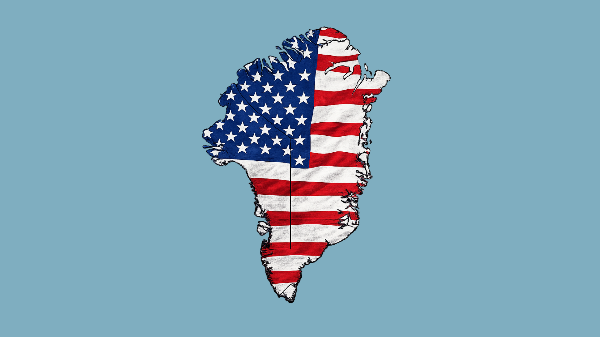
Since US President Donald Trump’s return to the White House, tensions have intensified with the EU as a result of Greenland’s strategic military significance which places it at the centre of geopolitical conflicts.
Historical Context
Historically, during WW2, the Danish ambassador in the States agreed with the sentiment that the US should occupy Greenland and construct military bases to prevent a German occupation. This agreement allowed America to build its northernmost military base at Pituffik. The Pituffik base served as a needed layover, allowing over 10,000 US jet fighters and bombers to land during WW2 to resupply on their way to Europe. Later in 1946, the US offered Denmark $100 million to purchase Greenland, to which the Danish refused.
After joining NATO, both countries signed the 1951 Greenland Defence Agreement - an agreement still in effect till date. The island is approximately half of Europe’s size, making it difficult for Danish troops to completely surveil the island with their troops, who patrol on dog sleds, and their few navy ships stationed along the coast.
Consequently, Denmark has relied on extensive US cooperation and support. This however has fuelled President Trump’s ambition of acquiring Greenland, because it represents a key naval chokepoint. The route between Greenland, Iceland, and the United Kingdom (also known as GIUK) is essential for NATO intelligence, allowing Russian vessels and submarines operating in the Arctic region to be monitored and contained.
The Economic Impact of Greenland
Greenland is a gateway to Arctic shipping routes. On 12 February 2025, a US Senate hearing outlined that the coast of Greenland was rich in mineral resources, a very rare commodity. Although the coast hosts precious metals, base metals, and industrial rocks, the exploration of the land to get to such commodities is incredibly challenging due to the rough terrain, consisting of deep fjords, glaciers and icy mountain ranges – a testament to the island’s harsh climate and inaccessible terrain. Therefore, any form of extraction is extremely expensive, requiring complex infrastructure investments.
Only major economies like the US can afford to incur such high costs. As climate change continues, the ice sheet surrounding Greenland is melting. Many US companies view this as an unprecedented economic opportunity to access new shipping routes and facilitate international trade.
The three main routes of interest are: (1) The Northwest Passage; (2) the Northern Sea Route; and; (3) the Transpolar Sea Route. These three function as a time and cost-effective alternative to the Suez Canal, significantly reducing shipping time between Asia, Europe, and the Americas. Although, the fishing industry is currently Greenland’s main economic source, it also heavily relies on Denmark’s annual 500-million-euro grant. This accounts for 50% of the island’s budget, allowing the government to spend around 10,000 euros per Greenland resident.
Legal Implications of the US Occupation
Law firms would have to:
- Draft a new international treaty between the US, Greenland, and Denmark, which would require consent via referendum in Greenland.
- Structure financial compensation for Denmark whilst also establishing a new trade deal between the Greenland and the US.
- Manage and negotiate the transfer of property rights and exploitation licenses for companies operating in Greenland.
- Organise Investor-State Dispute Settlements (ISDS) for foreign companies operating in Greenland, allowing them to sue the U.S. government for actions affecting their investments.
In addition, US law firms would be required to advise on US constitutional law as the treaty would need approval from the US Senate in order to commence.
Future Outlook
It remains to be seen how the increased commerce in the region will impact the island’s 57,000 inhabitants – 84% of which seek independence, viewing the US and EU as solely strategic partners.